INQ–γ: Visual Evidence
Verifying AI Predictions with Side-by-Side and Toggled Visual Evidence
Tools & Technologies: Visual explanations, human–AI interaction, PIPNet, CUB-200-2011
Under review at CHIIR 2027
Introduction
How do people use visual evidence to check an AI prediction? In a bird-identification task, this project compares showing two local image crops side by side with revealing them in the same position through a press-and-hold control. A 43-person study examines both judgment performance and whether participants actually open the additional evidence.
Two ways to compare
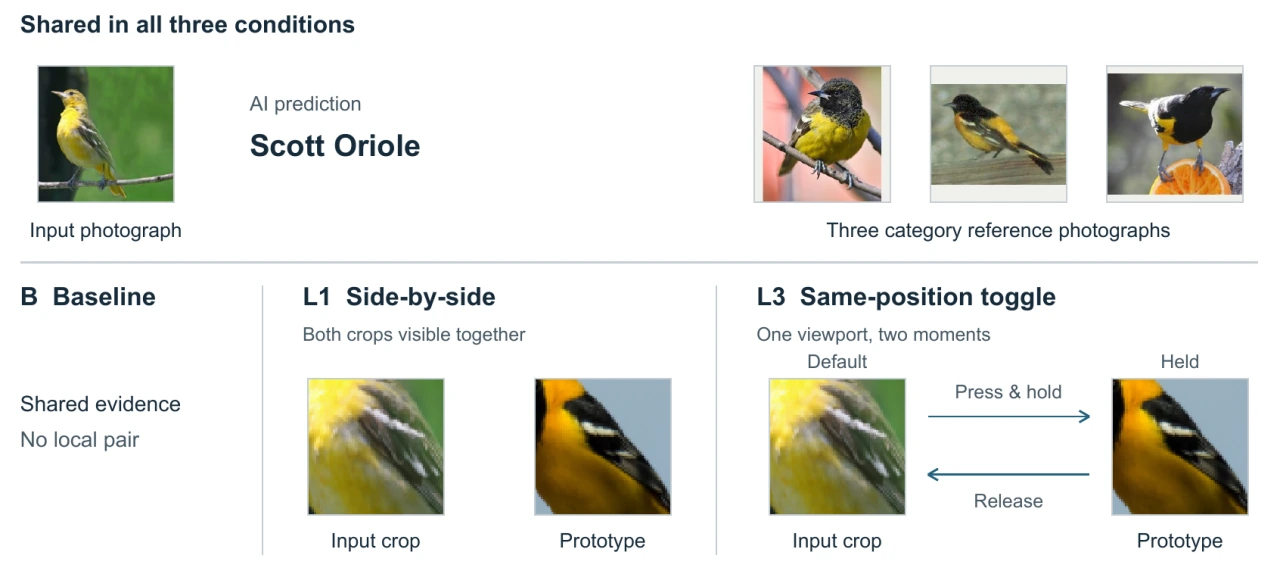
Every condition showed the input bird photograph, the AI’s proposed species and three category-reference photographs. The baseline added nothing else. The side-by-side condition displayed an input crop and a prototype crop together. The toggle condition showed the input crop until a button or key was held, revealing the prototype; releasing it restored the input.
Both comparison interfaces used the same image files. The crops showed a local match used by the model, while the reference photographs showed examples of the proposed species. The toggle kept crops in one viewport but did not anatomically align their features.
Study
Forty-three participants each judged 36 predictions, with 12 trials in each condition. For every case they decided whether the AI’s bird name was correct and rated their certainty. The primary analysis measured how well their judgments separated correct from incorrect predictions.
The study logged prototype revelation and collected one brief retrospective account per condition. These records distinguish evidence that was available from evidence that was displayed, without assuming that opening an image proves attention or understanding.
Findings
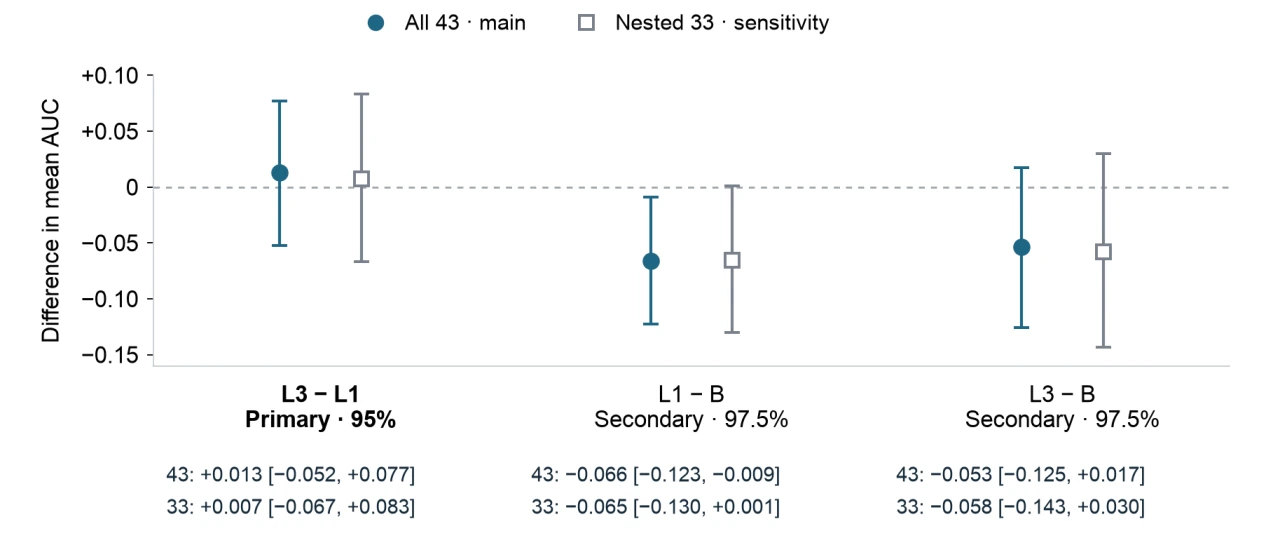
The primary difference in discrimination AUC, toggling minus side-by-side viewing, was +0.013, with a 95% confidence interval from −0.052 to +0.077. The estimate allows either a loss or a gain; it does not establish a benefit from toggling. Excluding the ten participants who never used the toggle did not resolve that uncertainty.
Participants revealed the prototype on 302 of 516 toggle trials. On the other 214 trials it remained undisplayed. Even among the 33 participants who toggled at least once, 94 of 396 trials contained no prototype revelation. Category-reference photographs remained available throughout.
Design implications
A comparison between interfaces also includes the access decisions those interfaces invite. Reporting whether supplementary evidence appeared on each trial helps explain what the performance estimate measures. It does not show whether the evidence was persuasive or useful for a particular judgment.
The study is limited to 43 participants and a selected pool of bird images; the crops’ usefulness for nonexpert verification was not independently validated. Separating viewing format from the action needed to reveal evidence would require a further study that controls exposure.